¬Ý
The Brown Water Navy
¬Ý
The Brown Water Navy LST
Yep. I was there. So were hundreds of thousands of other US Servicemen. Most came back in one piece, but far too many did not. 
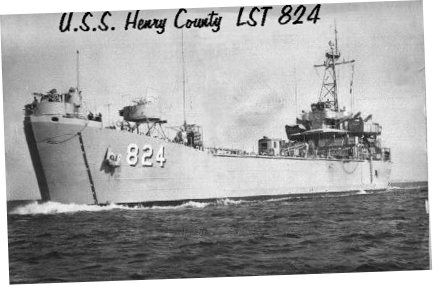
I was in the Brown Water Navy while in Viet Nam stationed on the USS Henry County, LST 824. The ship and I were born a month apart in 1944. The ship in Evansville, Indiana and me in Detroit. 
In WWII, ships like mine were used for landing tanks and men on the beaches¬Ýat places like Normandy and Tarawa. Hence, the name, Landing Ship Tank. In Nam however, we served in the Brown Water Navy. The Brown Water Navy term came about from the muddy, shallow rivers in the Mekong Delta. I must admit, I never heard the term Brown Water Navy until long after I was discharged. 
The WWII class LST was the sloth of the Navy. We were 325 feet long and carried 100 men. Top speed as about 11 knots. We cruised at 9 knots. Imagine crossing the Pacific at a brisk walk. 
The unique thing about a "T" was its flat bottom. The entire perimeter of the ship was made up of ballast tanks and small compartments. When buttoned up during a General Quarters, all of the sealed hatches and ballast tanks made it a hard ship to sink. With all of the tanks emptied, the "T" would sit high atop the water with just a few feet of draft. It was perfect for the shallow rivers of Viet Nam.
I was aboard the Hawk from 1963 to 1966. The Henry County crew nicknamed the ship the "Hawk" for a cartoon character named Henry Hawk. In Nam, Marines called us the "Grey Ghost of the Viet Nam Coast" because we had a habit of showing up in remote rivers and coastal locations at unexpected times to re-supply troops and equipment. The officers seemed to like the full moniker "Grey Ghost of the Viet Nam Coast" but the enlisted just liked "Hawk". I guess officers had more schooling and more time on their hands to wax poetic. (apologies about the cheap shot at officers-they were good men)
Once the LST’Äôs proved themselves as good river craft, they became more prolific in support activities. With the success of the Navy using "T’Äôs" in the rivers, success also came for the enemy as he learned how to blow them up. After I was home peacefully in the States, LST’Äôs were suffering losses to manpower and personnel. This was another piece of info I learned years later. It’Äôs sad to discover 30 years later that men you served with may have been killed.
Another thing I learned years later was that the Hawk was part of the nuclear bomb testing in the Pacific in 1962. I guess either the crew was sworn to secrecy or I never asked the right questions because when I reported for duty in June 1963 and left in November 1966, it was never discussed. It took the internet 30 years later to tell me what happened. 
As for combat, the Hawk was only fired upon once in Nam, maybe twice. We were sent deep into the Mekong to intercept and engage VC who were going to be crossing a river as they fled our Marines. They didn’Äôt cross the river but they did take a few shots at us from the shore with machine gun fire. We responded with our 40mm anti aircraft guns and a couple of Marine "Ontos" 105 Howitzer recoiless rifles. Each Ontos had 6 tubes. Three things were discovered during that engagement. First, the VC learned that their machine guns will not take out a 325 foot steel ship. The second lesson learned was by our gunners who discovered that unlike the endless drills and gunnery lessons, it’Äôs hard to stay in the seat of a gun when someone is shooting back. Nobody was injured but my-oh-my what salty language from a crusty old Gunners Mate directed at the men of the forward starboard turret for diving on the deck during a gun battle. The third lesson was there is SERIOUS recoil from a recoiless rifle. Pipes burst and valves gave way and sprayed water like a submarine under attack. I was down in the Engine Room at the time wearing a helmet liner and 30 year old life jacket. As a 20 year old kid all I could think about over the roar of the guns was the tons of 105 Howitzer ammo stacked up on the Tank Deck just above the Engine Room. The helmet liner kept the dust from the pipes out of my hair as I wondered how in the world did I come to be in this place.
The other time we took fire was early in 1963. We were about ¬‡ mile off the coast of Chu Lai or somewhere thereabouts. We were at General Quarters most of the day. Later, we received word one of our sister LST’Äôs was hit with an artillery shell that did not explode. A brave enlisted man extracted the shell and threw it overboard. We on the Hawk never even heard the shot. I guess that qualifies as getting shot at. 
So far, my mind is still full of memories, good and bad, of my time on the Hawk. They are fading fast. There are dozens of stories of my life aboard that ship. Most are just interesting to me and my shipmates. In retrospect, I love that ship. It was home and it’Äôs a part of what made me an adult and a proud American.
When I got out in late 1966 I was actually called a baby killer once while at a party. My wife quickly interceded before I became a hippie killer. That was as close to an atrocity as I ever got. There were no babies in my Engine Room!
Unfortunately I am not good at seeing the big picture where intellectual veterans say things like "My service is what makes America free and allows free people to say what they want". 
In my approaching elderly years, I would just love to have one more visit to the Henry County as it was back then. I also wouldn’Äôt mind being that young sailor once more who sat shaking under a helmet in a far away land.
Frank Gary EN3
Return to LST Home Porthttp://www.abiz4me.com/lst.htmlshapeimage_4_link_0
Copyright © 2007, Mershon, Inc.. All Rights Reserved.
¬Ý